
Lanzhou University ACB Team Precisely “Implants” Lanthanum Atoms into Co3O4 for Highly Efficient Low-Temperature VOC Purification
Researchers from the ACB team at Lanzhou University have developed a one-step co-doping strategy to precisely introduce lanthanum atoms into the spinel lattice of Co3O4, creating a highly active and water-resistant catalyst for low-temperature removal of volatile organic compounds (VOCs). By selectively substituting octahedral Co ions with La3+, the team induces lattice distortion, generates abundant oxygen vacancies, and activates surface oxygen species, thereby markedly enhancing oxidation performance.
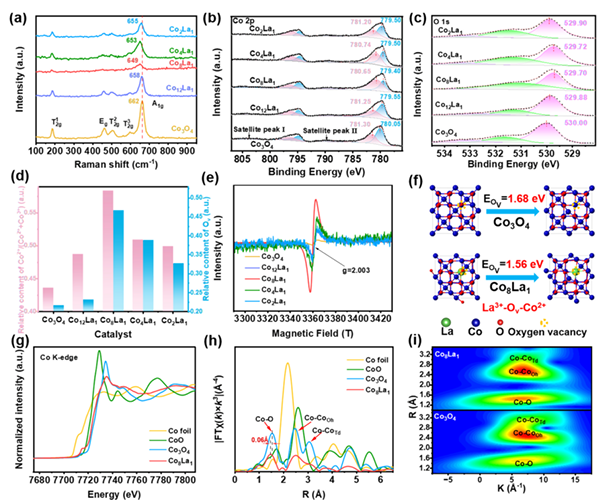
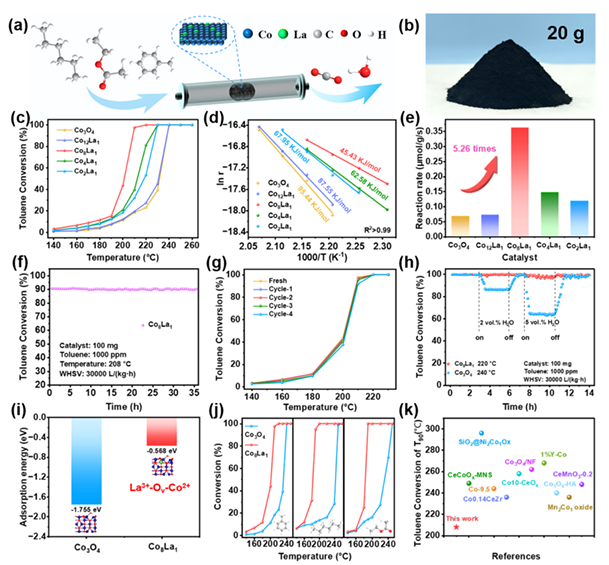
The La-doped Co3O4 catalyst exhibits a 2.16-fold increase in oxygen vacancy concentration compared with pristine Co3O4, promoting the formation of La3+–Ov–Co2+ interfacial sites. These defective sites effectively activate lattice oxygen, facilitate rapid oxygen species cycling, and accelerate the conversion of key intermediates such as benzoate species. As a result, the optimized Co8La1 catalyst delivers outstanding toluene oxidation performance, achieving T90 = 208 °C at 1 000 ppm toluene and a gas hourly space velocity of 30 000 L/(kg·h), with an apparent activation energy of only 45.43 kJ/mol.
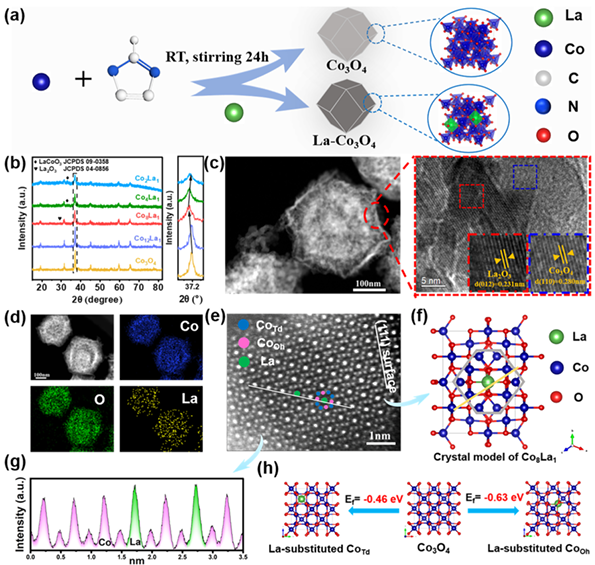
A suite of structural and spectroscopic characterizations confirms the atomic-level incorporation of La and the associated electronic and structural modulation. Diffraction and microscopy analyses show that La is uniformly distributed within the Co3O4 matrix and preferentially occupies octahedral sites, in line with thermodynamic calculations indicating a lower formation energy for La at these positions. Raman, XPS and EPR measurements collectively reveal weakened Co–O bonds, enriched oxygen vacancies, and increased adsorbed oxygen species, while X-ray absorption analyses indicate shortened Co–O bonds, reduced coordination numbers, and enhanced local distortion, all consistent with the formation of La3+–Ov–Co2+ interfacial structures.
In-depth catalytic evaluation demonstrates that Co8La1 not only exhibits the highest low-temperature activity among the tested catalysts, but also maintains excellent long-term stability. The catalyst shows no detectable activity loss during 35 hours of continuous operation and retains high performance under 5% H2O, highlighting its strong resistance to water-induced deactivation. Moreover, Co8La1 outperforms most reported systems in the oxidation of other representative VOCs such as n-hexane and ethyl acetate, with a reaction rate 5.26 times that of undoped Co3O4.
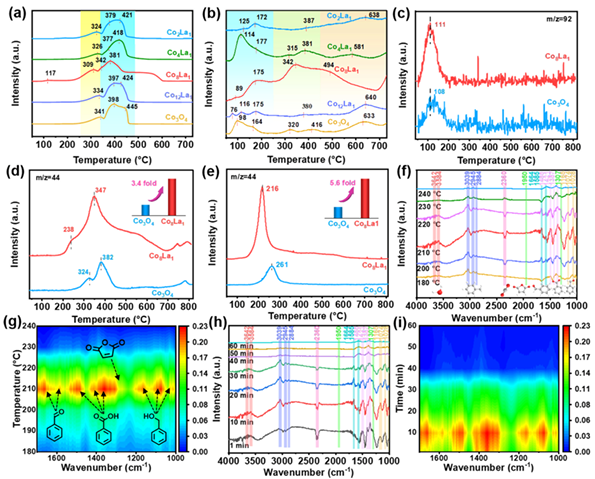
Temperature-programmed reduction and desorption measurements indicate that La doping significantly enhances the reducibility and mobility of lattice oxygen on Co8La1, which is crucial for Mars–van Krevelen-type oxidation cycles. Stronger toluene adsorption, lower CO2 formation temperatures, and higher CO2 yields further confirm the improved activation and conversion of VOC molecules on the La-modified surface. In situ infrared spectroscopy tracks a complete toluene oxidation pathway from toluene to benzyl alcohol, benzaldehyde, benzoate species, maleic anhydride, and finally CO2 and H2O, with the La-doped catalyst showing faster intermediate turnover.
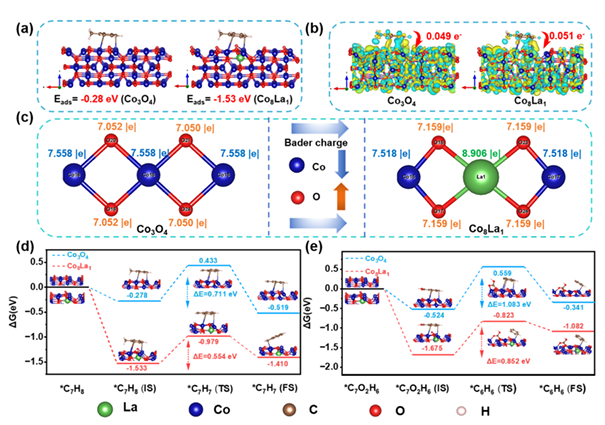
Density functional theory calculations provide atomic-level insight into the promotional role of La. Lanthanum doping optimizes toluene adsorption energy, enhances interfacial charge transfer, and redistributes electron density around Co and O, as evidenced by Bader charge analysis. These electronic effects significantly lower the activation barriers for C–H and C–C bond cleavage on Co8La1, directly correlating with the experimentally observed enhancement in low-temperature VOC oxidation activity.
Overall, this work demonstrates that precise La incorporation at octahedral sites in Co3O4 via a one-step co-doping strategy can construct oxygen-vacancy-rich La3+–Ov–Co2+ interfaces, delivering high activity, robustness, and water resistance for VOC abatement. The study not only offers a new atomic-level design concept for tuning spinel oxide catalysts, but also provides a promising candidate material for practical industrial VOC purification. Future efforts will explore the extension of this strategy to other rare-earth dopants, composite supports, and pilot-scale validation under real flue gas conditions.