
China’s Power Market to Undergo Greater Transformations in the Next Five Years
At the historic juncture marking the conclusion of the 14th Five-Year Plan and the commencement of the 15th Five-Year Plan, the development trajectory of China’s power industry is becoming increasingly clear, outlining a new vision for ensuring energy security and enabling green development.
During the 14th Five-Year Plan period, guided by the new strategy for energy security, China's power sector successfully achieved the dual goals of ensuring supply stability and facilitating a green transition. Over these five years, the country’s energy security capacity has seen leapfrog improvements. In 2024, China’s total electricity generation exceeded 10 trillion kilowatt-hours, accounting for one-third of the global total. Major energy "arteries" such as the West-East Electricity Transfer Project have not only transformed the resource advantages of the central and western regions into developmental momentum but also secured the energy demands of economically powerful eastern provinces. The construction of a nationally unified electricity market has been accelerated, with coal power and new energy sources fully integrated into the market, rapidly unleashing market vitality. The number of registered market entities in the electricity market has reached 970,000, five times that of 2020.
Looking ahead to the 15th Five-Year Plan period, the goal of "accelerating the comprehensive green transformation of economic and social development and building a Beautiful China" sets clear objectives for the power industry. This signifies that the sector will enter a critical phase in building a new energy system, advancing more rapidly towards cleaner, more resilient, and smarter development.
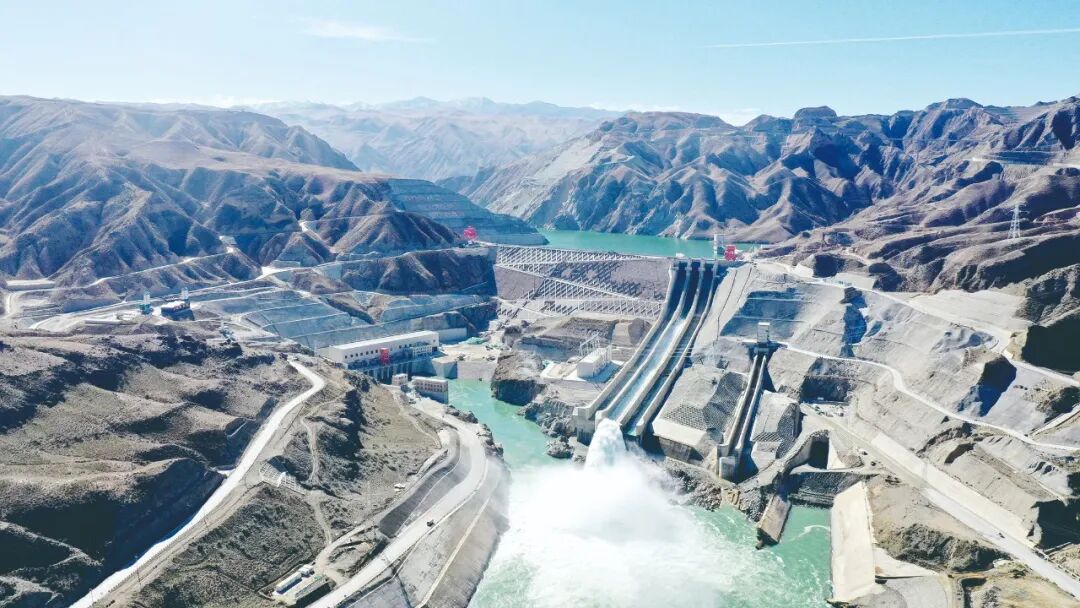
Photo: Yangqu Hydropower Station on the upper reaches of the Yellow River
Power Supply Capacity: Growth in Both Quantity and Quality
Since the 14th Five-Year Plan, driven by the dual objectives of energy transition and security of supply, China's power system has achieved transformative development. Overall electricity demand has shown steady growth, the power supply structure has been continuously optimized, with thermal, hydro, and nuclear power playing coordinated roles, and the prominence of non-fossil energy has become increasingly evident.
Data released by the National Energy Administration shows that by the end of August this year, the country’s cumulative installed power generation capacity reached 3.69 billion kilowatts, a year-on-year increase of 18%. This includes 1.49 billion kilowatts of thermal power capacity, up 5.5% year-on-year, with newly added capacity of 49.87 GW; 440 million kilowatts of hydropower capacity, an increase of 3.2%, with 6.84 GW of newly added capacity; and 60.94 GW of nuclear power capacity, growing by 4.95% year-on-year.
Looking forward to the 15th Five-Year Plan period, China's power supply capacity will be further enhanced. Wang Yongli, Deputy Director of the Energy Internet Research Center at North China Electric Power University, stated that during the 15th Five-Year Plan period, the roles and development approaches of "thermal, hydro, and nuclear" power will require profound adjustments to support the large-scale development of new energy and ensure power security. "The main idea is to shift from individual operations to coordinated efforts, building a multi-energy complementary, clean, and low-carbon energy system."
"Specifically, coal power units need to transition from being the primary baseload power source to providing support and regulation services. We should enhance deep peak-shaving retrofits of existing units, enabling them to undertake more system functions like peak shaving, frequency regulation, and reserves to ensure security, thereby freeing up generation space for new energy integration, while also serving as security backup during extreme weather. Hydropower units should evolve from being solely generation sources to becoming core components for system regulation and multi-energy complementarity, leveraging their fast start-stop and flexible operation characteristics to become ideal peak-shaving resources that mitigate fluctuations from new energy. Nuclear power units should shift from a purely baseload role to balancing baseload provision and system coordination, gradually exploring technologies and mechanisms for nuclear power to participate in grid peak shaving where safety and economic feasibility allow, thereby enhancing system flexibility," Wang Yongli explained.
Marketization as a Key Means for Power Resource Allocation
Market-oriented reforms have spurred the vigorous development of China's power industry. Since the 14th Five-Year Plan period, the volume of market-traded electricity in China has increased from 10.7 trillion kWh during the 13th Five-Year Plan period to 23.8 trillion kWh. The proportion of electricity traded in the market relative to total social electricity consumption has risen from 40% in 2020 to over 60% for four consecutive years. The transition from "planned electricity" to "market electricity" has accelerated, with substantive leaps and breakthroughs achieved in building a nationally unified electricity market, injecting strong momentum into high-quality economic and social development.
Li Chuangjun, Director of the New Energy and Renewable Energy Department of the National Energy Administration, described it this way: "We have been building like stacking blocks, gradually and orderly establishing a diverse and functionally comprehensive electricity market. Spatially, there are both intra-provincial and inter-provincial transactions; temporally, there are annual, monthly, intraday, and real-time transactions; in terms of product varieties, besides basic electrical energy, there are auxiliary services like peak shaving, frequency regulation, and reserves. It is especially noteworthy that this year has seen the normalization of cross-regional grid transactions, truly allowing 'the wind from north of the Great Wall to light up the lights in the Greater Bay Area.'"
Entering the next five years, power system reform will face many new challenges, and market-oriented transformations are bound to undergo deeper and more systematic adjustments.
Chen Yuguo, Strategic Consulting Director at Beijing Qingneng Interconnect Technology Co., Ltd., pointed out that the current theoretical framework of electricity markets, based on marginal cost bidding and clearing for various power sources, still requires further research and refinement. Market mechanisms and pricing systems that reflect the multi-dimensional value of electricity as a commodity urgently need to be established. The coordination and integration among different trading varieties also need strengthening. Simultaneously, the substantial power generation and grid resources constructed to meet users' short-term peak demand lead to capacity redundancy during low-demand periods, affecting resource utilization efficiency. "Additionally, the demand-side market is not yet fully open, user electricity prices do not reflect cost differences, and the price transmission mechanism between wholesale and retail electricity markets is not sufficiently sound," he added.
Xia Qing, a professor in the Department of Electrical Engineering at Tsinghua University, believes that during the 15th Five-Year Plan period, deepening power system reform should prioritize ensuring power system security, with promoting clean and low-carbon energy transition as the main goal. Continuous institutional and mechanism innovation will help achieve high-quality development of the new-type power system. "We can leverage prices to optimize resource allocation, innovate market entry mechanisms for new energy, accelerate capacity market development, establish a transparent transmission and distribution cost allocation mechanism, and create precise cost-transmission pricing mechanisms to facilitate high-quality development of the new power system. For example, by improving the price formation mechanism in capacity markets, we can fully reflect the long-term marginal costs of various power sources and ensure the transmission and allocation of capacity market costs to the user side. Balancing capacity adequacy with power supply reliability allows users to perceive the economic costs under different reliability levels. Market prices can incentivize demand-side responses in advance, achieving a balance in capacity supply and demand ahead of time, avoiding the operational risks of power projects being 'planned for birth but raised by the market,' and achieving economical and efficient supply security," Professor Xia Qing stated.
New-Type Power System Driving Energy Transition
Against the backdrop of deepening power system reform, the construction of the new-type power system has also achieved leapfrog development. Centered on the coordination of source, grid, load, and storage, it addresses the security and efficiency challenges posed by large-scale integration of new energy, laying a solid foundation for the low-carbon energy transition.
"During the 14th Five-Year Plan period, China's installed renewable energy capacity has remained the largest globally, but its 'weather-dependent' nature has become a core issue affecting grid security, stable operation, and the efficient utilization of renewables. In power systems with large-scale new energy integration, security and economy are key difficulties," Wang Yongli noted. "By building an integrated source-grid-load-storage power system, China has preliminarily achieved effective synergy between low-carbon goals, security, and economy."
To address spatial mismatch challenges, China has leveraged ultra-high voltage (UHV) transmission technology, proposing solutions suitable for the current situation of spatial disparity between resources and demand. For temporal matching, breakthroughs have been made relying on flexibility regulation technologies across the source-grid-load-storage chain. "China has been promoting the exploration and utilization of flexible resources across all segments. By the first half of this year, the scale of new energy storage installations in China reached approximately 95 GW; the deep peak-shaving load rate for coal power units has reached 20%, with some combined thermal-storage units breaking through to 10%; and flexible interaction modes like load management and virtual power plants on the demand side are gradually deepening," Wang Yongli said.
Looking ahead to the 15th Five-Year Plan period, Zheng Shanjie, Secretary of the Leading Party Members’ Group and Director of the National Development and Reform Commission, emphasized the need to accelerate the construction of the new-type power system to ensure that green power can be generated, connected by the grid, and efficiently used by end-consumers.
"China has enormous potential for new energy development, and the scale of new additions in the future will face greater challenges in terms of temporal and spatial mismatch," Wang Yongli suggested. "From a construction perspective, future efforts need to further break through technologies in offshore wind power, county-wide distributed photovoltaic promotion, and comprehensive utilization of hydrogen energy resources, promoting the transition of concentrated solar power (CSP) plants towards baseload power sources. On the integration side, it is necessary to further enhance the technological maturity and economic viability of new energy storage, while making breakthroughs in typical demonstration projects for localized green power consumption, such as direct green power connections, zero-carbon parks, and integration of power and computing. These will explore scenarios for the local consumption of new energy alongside emerging loads."
As the 14th Five-Year Plan draws to a close, the construction of the new-type power system has laid a solid foundation for green development. Facing the challenges of integrating even larger scales of new energy during the 15th Five-Year Plan period, continuous innovation across the source, grid, load, and storage segments will remain the core driver for the future energy transition.
Source:https://mp.weixin.qq.com/s/VzhgXaTcxKT7vYcgj7fHNQ