Palembang Waste-to-Energy Project Completes 72+24 Hour Trial Run: Advancing Urban Waste Treatment in Southeast Asia
In early October 2026, the waste-to-energy (WTE) project in Palembang, South Sumatra, Indonesia—invested in and developed by Zheneng Jinjiang Environment Holding Company Limited—successfully completed a continuous 72+24 hour full-load trial operation. The trial demonstrated stable performance across the facility's incineration systems, power generators, and flue gas purification units, marking the project's technical readiness for full commercial operations.
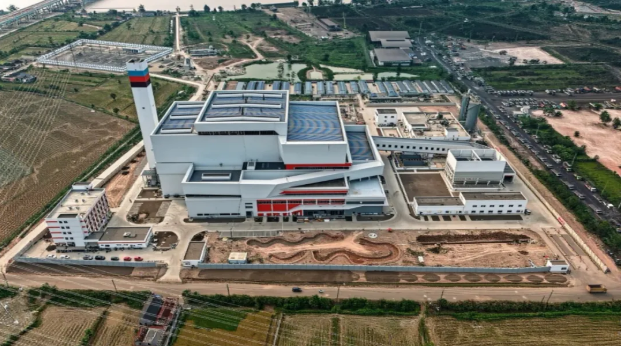
Palembang, the provincial capital of South Sumatra, has historically relied on landfills for municipal solid waste disposal. Rapid urbanization and population growth have intensified the pressure on local waste management systems, driving demand for alternative environmental governance solutions. In response, the Indonesian government has implemented national frameworks to accelerate waste-to-energy initiatives across urban centers. Designed to process 1,000 tonnes of municipal solid waste daily, the Palembang plant utilizes two 500-tonne/day mechanical grate incinerators paired with a 20 MW steam turbine generator set. The facility is expected to divert nearly 300,000 tonnes of waste from landfills annually, converting thermal energy from incineration into electricity fed into the regional power grid.
The progress at Palembang reflects a broader regional shift across Southeast Asia toward waste-to-energy solutions. Facing market saturation in their domestic market, Chinese environmental engineering and solid waste management companies have increasingly expanded across the region, bringing technical expertise in handling municipal waste with high moisture and variable calorific values.
Recent developments highlight this cross-border industry trend:
In Indonesia, Weiming Environment broke ground on a waste-to-energy facility in July 2026, alongside starting construction on a 1,500-tonne/day project in West Java. Under national initiatives, major international developers—including China Everbright Environment, Grandblue Environment, and others—have secured contracts for urban waste-to-energy projects in key urban centers such as Lampung, Surabaya, and Bekasi.
In Vietnam, China Tianying's major waste-to-energy plant in Hanoi (designed for 4,000 tonnes/day) operates continuously alongside expansion phases, while Everbright Environment's facility in Cần Thơ processes roughly three-quarters of the city's daily municipal waste.
In Thailand, Grandblue Environment supported the commissioning and testing phases of the 1,400-tonne/day On Nut waste-to-energy project in Bangkok.
As Southeast Asian municipalities move away from conventional landfilling, these cross-border partnerships illustrate the region's transition toward integrated resource recovery. While providing alternatives for urban waste management, such international infrastructure projects continue to navigate local regulatory compliance, long-term waste supply agreements, and cross-border financial and currency risk management.