Whole chain, multi-scenario, cracking the low-value waste recycling problem like this
The face of low-value recyclables ‘no one wants to collect, no profit can be collected’ the reality of the dilemma, Hangzhou Fulun Eco-Technology Co., Ltd. to explore a set of ‘the whole chain of closed-loop recycling model’, so that the rubbish really be
Recycling model for low-value recyclables in Hangzhou Fulun
Multi-scenario layout
Responding to the three real problems of low-value recycling
The prominence of Fulun's waste-free model lies in its flexible adaptability and systematic recycling network. Unlike the local programme of a single scenario, the six recycling scenarios constructed by Fullen basically cover all kinds of life and consumption scenarios in the city, which has a strong reference value.
Issue 1: Conventional recycling network is difficult to cope with the diversity and variability of garbageWithout Waste, Fullen makes an effort to make the recycling system more flexible, and achieves the goal of ‘not changing the habits of the residents, but improving the recycling rate’ through the design of refined scenarios. The key is to adapt the system to the people, not the people to the system. The network is not one-size-fits-all, but tailored to the characteristics of the waste generated in different scenarios.
Core insight: The Fulen Waste Free model extends and customises the recycling network to the front end through a reverse logistics system, oriented to the demand for resourcefulness at the back end, avoiding duplication of construction and achieving effective aggregation of resources.
Customised Recycling System for All Scenarios
Problem 2: Low-value ‘unprofitable’, the government's financial pressure FULLEN waste-free model through technological breakthroughs, breaking the economic bottleneck of low-value rubbish resourcing, to achieve a win-win situation for both the environment and the economy, and to truly achieve the ‘no increase in the budget, but for the government to save money’.
Closed-loop regeneration system: covering multiple links from recycling, sorting to regeneration, realising a step-by-step increase in value. Scale effect: Multi-scenario coverage brings diversity of treatment types, which helps to realise scale effect and economy of scope.
Taking West Lake District as an example, the cost of domestic waste treatment in the district has dropped from RMB 488.57/tonne to RMB 335.57/tonne, a reduction of RMB 153 per tonne of treatment cost, which in turn reduces the amount of money the government pays for waste treatment, thanks to the reduction in the amount of incineration as well as the return of value brought by the product of resourcefulness.
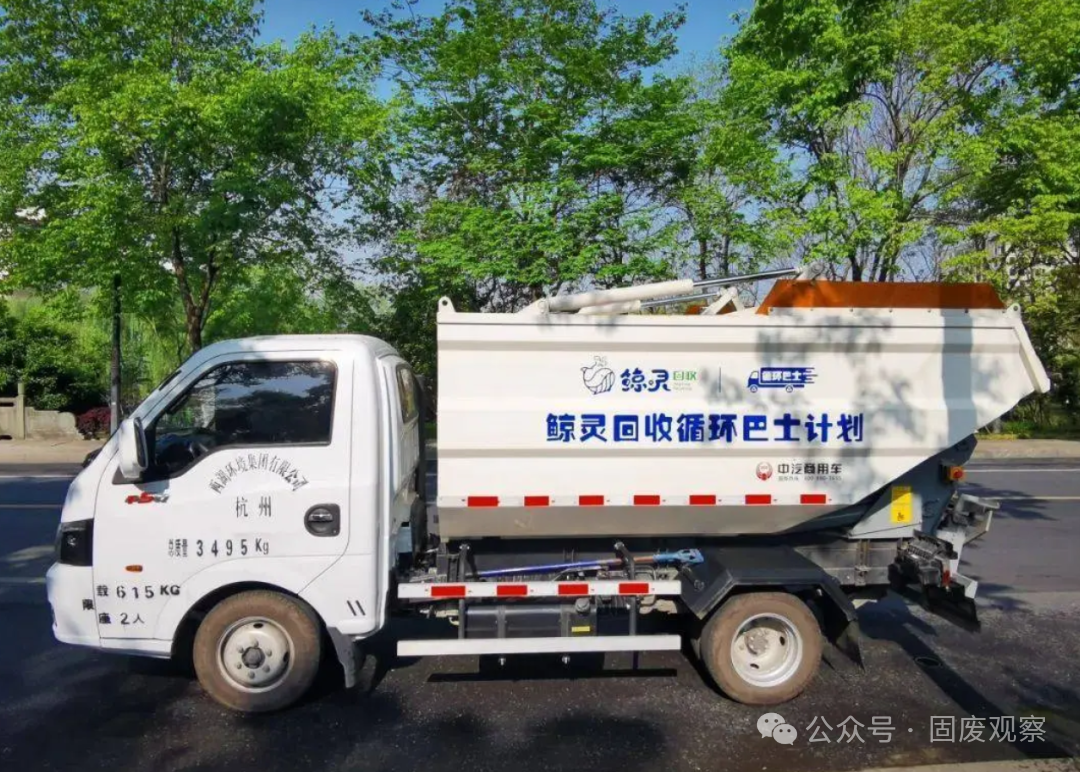
The ‘Whale Spirit Recycling Bus’ in the Westlake model
Problem 3: Difficulty in government-enterprise collaboration and regional differences The Fullen Waste Free model has shown flexibility in its promotion, forming two mature government-enterprise cooperation paths that are suitable for regions with different basic conditions.
1. Binjiang model (market-based operation): Characteristics: Through public bidding, market-based enterprises with technical and cost advantages are selected to be responsible for waste collection and resource treatment. Advantages: Full competition helps control costs and improve efficiency. The high reduction rate in Binjiang District proves the vitality and effectiveness of the market-based model under specific conditions. 2. Westlake model (government-enterprise synergy-based): Characteristics: Westlake District's model is characterised by the dominance of state-owned enterprises (SOEs), with district SOEs being responsible for the front-end collection and transportation and cooperating with specialised enterprises to handle the middle and back-end, with an emphasis on stability and systematicity of public services. Advantage: It can better leverage the stability and public attributes of state-owned enterprises, integrate the resources of the existing municipal system, and coordinate the implementation of policies. This model of ‘collection and transport by state-owned enterprises + treatment by private enterprises’ solves the problems of high cost and difficult supervision of low-value waste recycling by complementing each other's strengths.
The ‘two-network integration’ is a key strategy in China's waste management field, the core of which is to reduce, resource and harmless waste treatment by integrating the domestic waste classification and collection system with the recycling system. By extending the industry chain upwards (integrating recycling and treatment) and collaborating horizontally with multiple actors (government, collection and transportation units, and 6 closed scenarios), Fullen has realised a regional ‘integration of the two networks’.
It is worth mentioning that the team of Fullen especially pointed out that the key to promoting low-value waste recycling in rural counties lies in ‘finding county administrators who are willing to reform’. Whether it is a market-based or state-enterprise co-operation model, the openness and determination of local leaders is the first condition for the project to break through the administrative barriers and successfully land on the ground. Through successful benchmarking cases, local governments can see for themselves the practical benefits of turning rubbish into resources, thus breaking the wait-and-see mentality, and jointly exploring a new, economically sustainable way of rubbish management that is suitable for small counties.
Challenges
Four major blockages in the promotion of the model
Despite the remarkable results, the person in charge of Fulun also admitted that low-value waste recycling still faces a lot of challenges. In order to achieve effective promotion and replication of the model, the following problems still need to be overcome: administrative barriers, difficult to transport across the region: the existing waste treatment system is based on administrative boundaries, which restricts the efficient flow of low-value waste across the region and the scale of treatment. Land constraints, difficult to land the project: the nature of the land for resource utilisation plants has not been clarified, and enterprises are struggling to acquire land and handle landing permits. Conceptual change, still need to be tackled: the existing disposal system and franchise model, to a certain extent, solidified the incineration-centred pattern. The government's mindset and attitude towards secondary sorting of other waste has only just begun to change. Balance of interests, is the key to the sustainable development of the industry: the development of the reuse industry will impact on the waste incineration industry, but the two may not be completely opposed to each other, need to find a collaborative mechanism to achieve complementary coexistence.
Future Prospects
From Hangzhou sample to national promotion
The Fulun model has shown strong applicability. In Shaanxi, Green Earth and other enterprises have drawn on a similar model to achieve an annual recycling of more than 50,000 tonnes of rubbish through the operation of the whole chain, saving more than 20 million yuan in disposal costs [2].
From the practice of Hangzhou, cracking the rubbish problem not only requires technological innovation, but also the construction of a synergistic mechanism of ‘government-led, enterprise operation, public participation’.